A hard drive certificate of destruction is a formal document that acts as legally recognized proof that your sensitive data has been permanently and irretrievably wiped out. For business owners, IT managers, and corporate sustainability leaders, it’s far more than a simple receipt—it’s your official record for compliance audits and your shield against liability if a data breach ever comes knocking.
Why a Destruction Certificate Is Your Final Defense in Data Security
In a world run on data, just deleting files or formatting a drive is dangerously naive. Old IT assets are often packed with lingering data—from employee records to customer financial details—and that represents a massive liability. A breach traced back to improperly disposed-of equipment can trigger devastating consequences, like steep regulatory fines, lawsuits, and a hit to your reputation that’s hard to come back from.
This is where a hard drive certificate of destruction becomes non-negotiable. It’s the final, critical piece of the IT Asset Disposition (ITAD) puzzle, giving you tangible evidence that your organization did its due diligence. Think of it as the official, notarized end to a data-bearing asset's life, closing the loop on both security and compliance.
The True Purpose of a Certificate
The certificate's job isn't just for your internal files. It’s an externally recognized document that proves you're serious about data privacy regulations. This piece of paper is essential for showing you comply with standards like HIPAA for healthcare info, GDPR for consumer data, and FACTA for financial records. Without it, you have no verifiable way to prove you followed proper data destruction protocols.
This document bridges the gap between the physical act of destruction and your legal duty to protect data. It confirms that specific assets, identified by unique serial numbers, were destroyed using a specific method on a specific date—all handled by a vendor you can trust.
A robust certificate of destruction isn’t just a best practice; it's a fundamental part of a modern risk management strategy. It provides the auditable proof needed to defend your organization against claims of negligence and shows you're proactive about data security.
Integrating Destruction with Responsible Disposal
Choosing the right ITAD partner is everything, since the certificate is only as good as the provider’s credibility and process. A social enterprise like Reworx Recycling weaves certified data destruction into a complete, responsible disposal strategy. This approach makes sure your business is protected while also hitting your corporate sustainability targets.
When you partner with a social enterprise that focuses on donation-based recycling, you accomplish two huge goals at once:
- Secure Data Destruction: You get a legally defensible certificate for every single hard drive destroyed, guaranteeing compliance.
- Community Impact: Your non-data-bearing assets and recycled materials go on to support community programs, promoting digital inclusion and environmental responsibility.
This dual-benefit model turns a routine compliance task into a chance to strengthen both your security and your company's social responsibility profile. The certificate you get from Reworx Recycling is more than proof of destruction; it’s evidence of a commitment to protecting your business and empowering your community.
What a Valid Certificate of Destruction Actually Contains
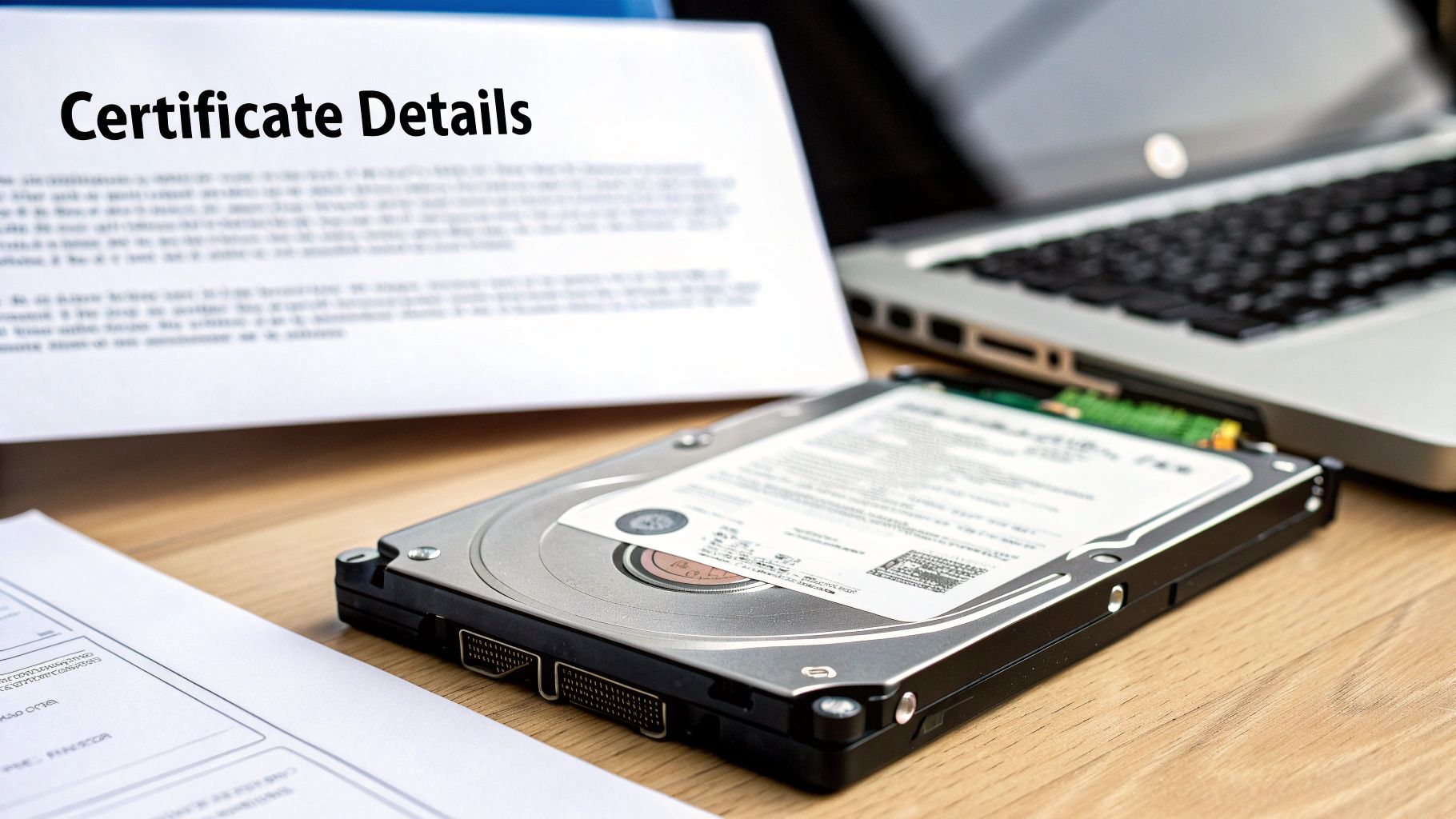
It’s a common misconception that all certificates are created equal. In reality, a legitimate hard drive certificate of destruction is much more than a simple receipt. Think of it as the final, legally binding chapter in your data's story—a document that must hold up under the intense scrutiny of an audit or legal challenge.
A vague or incomplete certificate is practically worthless, offering a false sense of security. To be truly protected, you need to know what to look for. The right details create an unbreakable, auditable record that proves you did your due diligence.
Core Components of a Legitimate Certificate
Every proper certificate of destruction is built on a foundation of specific, verifiable information. If any of the following details are missing, you should see it as a major red flag. These elements ensure total traceability and accountability.
The essentials include:
- Unique Serial Numbers: The certificate has to list the individual serial number for every single hard drive or device that was destroyed. A generic line item like "15 hard drives" just doesn't cut it and fails to prove your specific assets were processed.
- Method of Destruction: The document needs to be explicit about how the drives were destroyed. Common methods like shredding, degaussing, or crushing should be clearly stated, especially to meet compliance standards like NIST 800-88.
- Date and Location of Destruction: This pinpoints exactly when and where the destruction occurred. It’s a simple but critical detail for building a verifiable timeline and chain of custody.
- Authorized Signatures: A representative from the destruction company must sign the certificate, formally attesting that all the information is accurate. This signature makes them accountable.
These details transform a piece of paper into a powerful legal tool. For a clear picture of what a professional document looks like, it’s helpful to review a comprehensive destruction certificate template. This will help you set the right expectations for your vendor.
A certificate of destruction is a critical document, but it's easy to overlook a key detail. The following checklist breaks down the essential components that make a certificate legally defensible, helping you confirm you've received documentation you can trust.
Checklist for a Legally Defensible Destruction Certificate
| Component | What It Is | Why It's Non-Negotiable |
|---|---|---|
| Client Information | Your company's full legal name and address. | Confirms the certificate is issued to the correct entity. |
| Vendor Information | The destruction company's name, address, and contact info. | Establishes who is accountable for the service. |
| Unique Certificate ID | A serialized or unique tracking number for the document. | Ensures the certificate is authentic and can be referenced easily. |
| Asset Serial Numbers | An itemized list of serial numbers for each destroyed device. | Provides definitive proof that your specific assets were destroyed. |
| Destruction Method | A clear statement of the technique used (e.g., shredding, degaussing). | Proves compliance with data security standards like NIST 800-88. |
| Date & Location | The exact date and physical address where destruction took place. | Creates a verifiable timeline for your audit trail. |
| Authorized Signature | The signature of a representative from the destruction vendor. | Legally attests to the accuracy of the certificate's contents. |
| Chain of Custody Ref. | A reference number linking to the chain-of-custody documentation. | Connects the final certificate to the secure handling process. |
Using this checklist ensures your certificate of destruction isn’t just a formality but a robust piece of evidence that protects your organization.
Chain of Custody Documentation
Beyond the certificate itself, you need to think about what happened before destruction. The certificate is the final piece of a secure chain-of-custody process—the documented trail that tracks your assets from the moment they leave your hands to their final destruction.
A certificate of destruction is only as trustworthy as the chain of custody that precedes it. Without a documented, secure transfer process, the certificate loses much of its legal weight.
A solid certificate will often reference this process and should be supported by documentation that includes:
- Transfer of Custody Details: Names and signatures of the people who handled the assets at every step.
- Secure Transport Confirmation: A statement confirming the assets were moved in a secure, locked, and tracked vehicle.
- Service Provider Information: The full name, address, and contact details of the certified vendor, like Reworx Recycling, that performed the service.
When you partner with a trusted social enterprise like Reworx Recycling, you receive a certificate that doesn't just check the boxes—it reflects a deep commitment to responsible and secure ITAD. This level of documentation gives you true peace of mind, knowing your data is gone for good and your compliance duties are met.
Connecting the Certificate to Data Privacy Compliance
A hard drive certificate of destruction is far more than just a receipt for your old equipment. Think of it as your official, legally-defensible proof that you’ve met your compliance duties in a world full of strict data privacy laws. Simply saying you destroyed old gear just won’t cut it anymore.
This certificate is the critical piece of evidence linking your IT asset disposal (ITAD) efforts to your legal obligations. It’s exactly what you’d show a regulator during an audit or, in a worst-case scenario, what your lawyers would use in a data breach investigation. It’s your proof of taking proactive, verifiable steps to protect sensitive information, directly answering the disposal requirements baked into countless regulations. Without it, you're left with just your word against a claim of negligence.
Real-World Scenarios and Regulatory Alignment
Different industries face their own unique compliance hurdles, and a certificate of destruction is a surprisingly versatile tool for clearing them. Its value really clicks when you see how it applies to specific regulatory frameworks that demand proof of secure data handling from start to finish.
Let's look at a few common business situations:
- Healthcare and HIPAA: A hospital is retiring a batch of old servers and the kiosks from patient check-in. To comply with the Health Insurance Portability and Accountability Act (HIPAA), they need to do more than just unplug them. A detailed certificate that lists the serial numbers of every single destroyed hard drive proves the hospital took the necessary steps to protect patient health information (PHI) and keep it out of the wrong hands.
- Finance and GLBA/FACTA: A bank is upgrading its entire IT infrastructure. It's bound by the Gramm-Leach-Bliley Act (GLBA) and the Fair and Accurate Credit Transactions Act (FACTA). The certificate of destruction confirms that all customer financial records and personally identifiable information (PII) were disposed of securely. This satisfies auditors and helps the bank sidestep massive fines.
- Global Operations and GDPR: A tech company has customers in Europe, which means it must follow the General Data Protection Regulation (GDPR). This law gives people the "right to be forgotten." The certificate provides undeniable proof that the data of EU citizens has been permanently wiped from decommissioned devices, fulfilling one of the regulation's core rules.
Getting this documentation has become absolutely essential with the rise of data protection laws around the globe. These certificates are your legal shield, proving that sensitive data has been securely and irreversibly destroyed—a non-negotiable step for any organization handling regulated information.
The Certificate as Your Legal Safeguard
During an audit, regulators don't just ask about your policies; they want to see proof that you actually follow them. A hard drive certificate of destruction is exactly that. It's a time-stamped, serialized, and officially witnessed record of your compliance in action, making it an incredibly powerful tool for managing risk.
This document flips the script on the burden of proof. Instead of you scrambling to prove you were compliant, the certificate stands as a formal statement from a certified third party. It shows you met your legal and ethical duties to protect sensitive data.
This is especially critical when you're navigating complex regulations. For a deeper dive into the legal frameworks that make these measures so necessary, it’s worth exploring the intricacies of data privacy law. Understanding the legal landscape makes it crystal clear why a simple "we junked it" is no longer enough and why formal certification is a must.
Partnering with a certified ITAD provider like Reworx Recycling turns a complex legal requirement into a smooth, secure process. By following recognized e-waste certification standards, Reworx guarantees that every certificate we issue is backed by a process that’s transparent, secure, and fully compliant. This transforms the certificate from a piece of paper into a cornerstone of your data governance strategy, giving you peace of mind and a rock-solid legal defense.
Building an Unbreakable Chain of Custody
The value of your hard drive certificate of destruction is directly tied to the integrity of the process that comes before it. This crucial step is the chain of custody—a meticulous, auditable trail that tracks every single data-bearing asset from the moment it leaves your facility to its final, verified destruction.
Think of it like a high-stakes relay race. The baton is your sensitive data, and it must be passed securely from one trusted handler to the next without ever being dropped or left unattended. A gap in this chain invalidates the entire process and, by extension, the certificate that follows.
This documented journey is what gives the final certificate its legal and practical authority. It proves that no device mysteriously vanished in transit, was improperly handled, or was swapped out before reaching the destruction facility.
Key Stages in a Secure Chain of Custody
A truly unbreakable chain of custody isn't just a vague promise; it's a series of concrete, verifiable actions. Each step is designed to eliminate risk and create a transparent record. When you partner with a professional ITAD provider, these stages are non-negotiable.
Here’s what that process looks like:
- Secure Collection and Transport: It all starts at your location. Assets are inventoried and loaded into secure, locked containers. The transport vehicles should be GPS-tracked, and every team member involved must be vetted and trained in secure data handling.
- Serialized Check-In: Once the assets arrive at a secure, access-controlled facility, each container is opened. Every single device is individually scanned and reconciled against the initial inventory list. This confirms that everything that left your building has arrived safely for processing.
- Monitored Internal Movement: Inside the facility, your assets are continuously tracked as they move toward the destruction area. This internal tracking prevents any device from getting misplaced or diverted before it's time for destruction.
- Witnessed Destruction: For the highest level of assurance, many services offer witnessed destruction, either in person or via a secure video feed. This gives you the chance to observe your specific, serialized assets being physically destroyed.
This rigorous, step-by-step accountability is the foundation of a reliable IT asset disposition program. To see how this fits into a broader strategy, you can explore what is IT asset disposition and its role in modern data security.
Why This Process Matters for Your Certificate
The connection between the chain of custody and your certificate is absolute. Without a documented chain, a certificate is just a piece of paper. It lacks the supporting evidence to prove that the assets listed were the ones actually destroyed.
The chain of custody is the narrative, and the certificate of destruction is the conclusion. One cannot be trusted without the other. It provides the verifiable proof that your data was protected at every single point in its end-of-life journey.
This becomes especially critical during a compliance audit or a legal dispute. An auditor won't just ask for the certificate; they will demand the supporting chain-of-custody logs. They want to see the complete, unbroken trail of documentation that validates the certificate's claims.
When you partner with a social enterprise like Reworx Recycling, our transparent protocols are designed to maintain this unbreakable chain from start to finish. We understand that our corporate clients need more than just a service—they need irrefutable proof of compliance. Our meticulous tracking and serialized reporting ensure that the hard drive certificate of destruction you receive is a document you can trust, backed by a process that stands up to the most rigorous scrutiny.
Choosing the Right Data Destruction Method
Not all data destruction methods are created equal. The specific technique listed on your hard drive certificate of destruction carries a lot of weight and has a huge impact on its compliance value. Picking the right one ensures your sensitive data is truly gone for good and that your certificate will hold up under the toughest scrutiny.
Ultimately, the choice between physical destruction and software-based erasure comes down to your data's sensitivity, your industry's regulations, and your own internal security policies. Understanding the main methods is the first step toward making a smart decision. Each one offers a different level of security and serves a distinct purpose.
Comparing Standard Destruction Techniques
Three methods really dominate the industry, and each comes with its own set of pros and cons. A knowledgeable partner like Reworx Recycling can walk you through the most appropriate and cost-effective option for your specific assets, making sure the method you choose lines up perfectly with your compliance needs.
- Physical Destruction (Shredding): This is the most final method, hands down. A specialized industrial shredder grinds hard drives and other media into tiny, jumbled fragments of metal and plastic. At that point, data recovery is physically impossible. It’s the gold standard for highly sensitive data and is often required by strict regulations.
- Degaussing: This technique uses an incredibly powerful magnetic field to instantly and completely scramble the magnetic data stored on a hard drive's platters. It renders the drive totally unusable and the data permanently erased. Degaussing is extremely effective for traditional magnetic hard drives, but keep in mind, it doesn’t work on Solid-State Drives (SSDs).
- Data Erasure (Software Wiping): This approach uses specialized software to overwrite all the existing data on a hard drive with random binary code. When done right—following a high standard like NIST 800-88—it can securely sanitize a drive, which allows it to be safely reused or resold. The catch? It requires a functioning drive and can be a pretty time-consuming process.
For businesses trying to balance top-notch security with sustainability, it’s worth exploring the different strategies for hard drive destruction and seeing how they fit into a bigger asset management plan.
Adhering to NIST 800-88 Standards
The National Institute of Standards and Technology (NIST) Special Publication 800-88, "Guidelines for Media Sanitization," is the go-to framework for data destruction. It lays out clear, trusted procedures for clearing, purging, and destroying data based on its sensitivity level.
When a certificate of destruction references compliance with NIST 800-88, it’s a clear signal that your vendor is following federally recognized best practices. That simple reference adds significant weight to your compliance records.
The image below shows the kind of streamlined, secure process that has to happen for a certificate of destruction to be trustworthy.
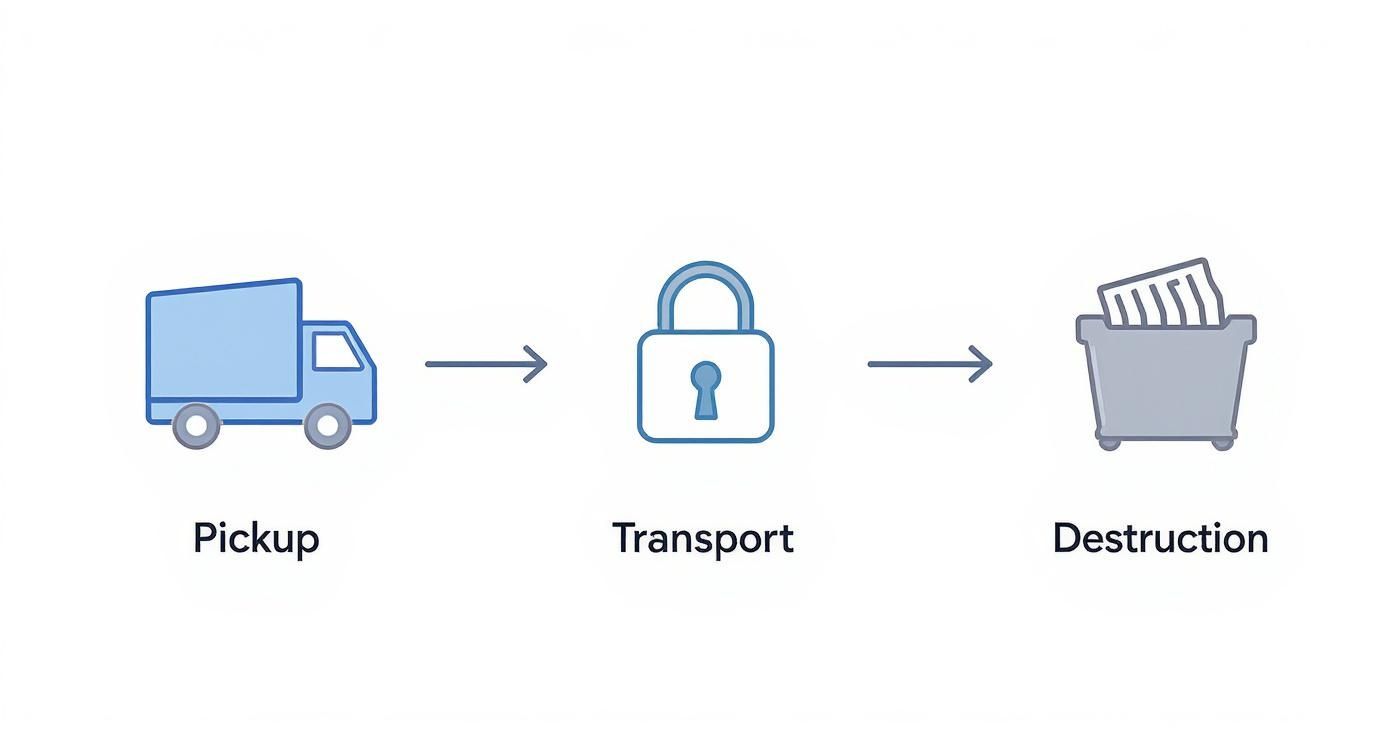
This process really drives home how a secure chain of custody—from the moment your drives are picked up to their final destruction—is absolutely essential for the certificate to be valid.
Achieve Compliant ITAD with Reworx Recycling
Choosing a partner for your IT Asset Disposition is a big deal. This decision has ripple effects on your data security, your compliance with regulations, and even your company's reputation. You need a provider who not only gets the technical side of secure data destruction but also understands your bigger picture goals for social and environmental responsibility.
At Reworx Recycling, we’ve built a complete solution that transforms a simple compliance task into a chance to make a positive community impact. Our process is designed to handle every hard drive with the highest level of security, giving you a legally sound hard drive certificate of destruction so you can rest easy.
Your Partner in Security and Social Good
Our donation-based model is what truly makes us different. Of course, our number one job is protecting your sensitive information through certified data destruction. But we also believe that technology has the power to lift up communities. When you work with us, you’re not just getting rid of old equipment—you’re helping fuel digital inclusion and workforce development programs.
It’s a simple, straightforward process:
- Schedule a Pickup: We’ll work with you to arrange a convenient time to pick up your old IT gear.
- Secure Destruction: We perform certified physical destruction on every single data-bearing device. No exceptions.
- Receive Your Certificate: You get an official certificate that details every destroyed asset, tracked by its serial number.
- Support the Community: Any non-data-bearing and refurbished equipment goes on to help support local programs.
This approach lets your organization move forward confidently, knowing your data is gone for good and your retired assets are now creating real value for others. This kind of verified destruction is a cornerstone of responsible corporate donation programs and sustainable recycling initiatives.
Partnering with Reworx Recycling means you get more than just a certificate. You get proof of your commitment to robust data security, environmental stewardship, and community empowerment—all in one seamless service.
Take the Next Step with Confidence
Protecting your business while giving back to the community is a powerful combination. Our team is ready to help you build a secure and socially conscious ITAD program that fits your organization's specific needs. We handle it all, from office cleanouts and data center decommissioning to the responsible recycling of laboratory and medical equipment.
By choosing our comprehensive IT asset disposition services, you can be sure that every single step, from pickup to final certification, is managed with professionalism and total transparency. Contact Reworx Recycling today to talk about how our secure IT equipment disposal and donation programs can help you hit both your security and sustainability goals.
Frequently Asked Questions
When you're dealing with data destruction, a lot of questions pop up for business leaders and IT managers. Let's clear up some of the most common ones about the hard drive certificate of destruction so you can be confident your ITAD process is buttoned up and compliant.
How Long Should We Keep a Hard Drive Certificate of Destruction?
Our recommendation? Keep them forever. Think of them as permanent legal and compliance records. While some general data retention policies suggest seven years, that's often not long enough to prove you did your due diligence if something comes up years down the road.
For sensitive information governed by strict rules like HIPAA, permanent retention is the only truly safe strategy. It ensures you’re always ready to defend against future audits, legal questions, or negligence claims that might surface long after the equipment is gone.
Is a Certificate for Software Wiping as Valid as One for Shredding?
Yes, a certificate for software wiping is valid, but there's a big "if"—if it certifies erasure to a recognized standard like NIST 800-88. The real choice between wiping and shredding comes down to how sensitive your data is and what you plan to do with the drive afterward.
A certified wipe is usually fine for standard corporate data and allows the hard drive to be safely reused or refurbished. But for the heavy-duty stuff—patient records, financial data, or top-secret R&D—physical destruction is the undisputed champion. A shredding certificate offers the highest level of assurance, and a partner like Reworx Recycling can help you figure out the right call for your situation.
What if a Vendor Provides a Generic Certificate Without Serial Numbers?
That’s a huge red flag. A non-serialized certificate that just says "100 hard drives destroyed" is practically worthless. It fails to prove that your specific hard drives were the ones that were processed, leaving you with very weak legal protection that won't hold up in an audit.
You should always insist on a certificate that lists every single hard drive by its unique serial number. If a vendor can't or won't provide that level of detail, it's a strong sign their chain-of-custody and tracking processes aren't up to professional standards.
Can We Get a Certificate of Destruction When Donating Computers?
Absolutely. At Reworx Recycling, data security is a non-negotiable part of our donation and recycling process. If any donated devices contain hard drives or other storage that can't be securely wiped for refurbishment, we move straight to certified physical destruction.
You will receive a formal hard drive certificate of destruction for those assets. This way, your company can support great community initiatives while knowing you’ve upheld the highest standards of data protection.
Ready to secure your data and make a positive community impact? Partner with Reworx Recycling for certified data destruction and responsible electronics recycling. Explore our services and schedule a pickup today.